
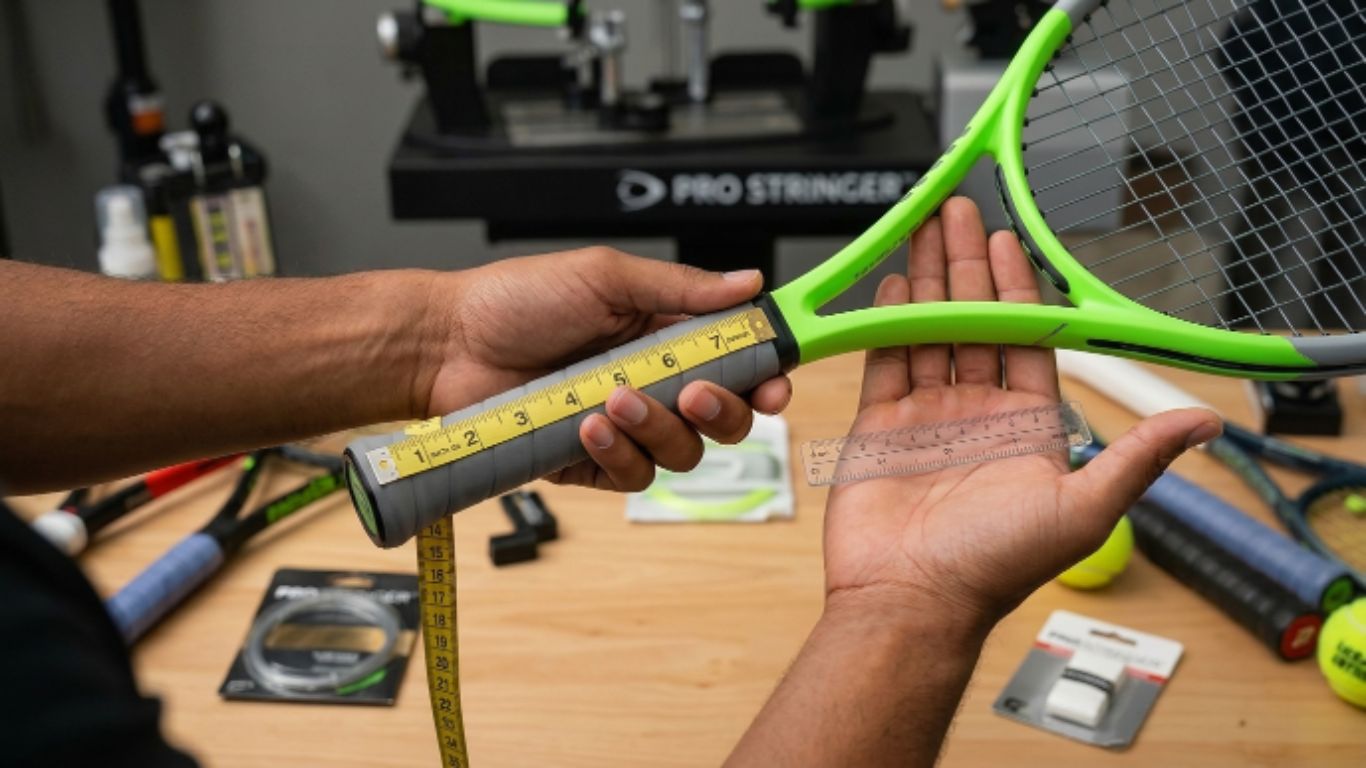
Choosing the right tennis racket grip size is one of the most overlooked aspects of tennis equipment. Players often spend hours researching racquets, strings, and accessories but rarely pay enough attention to the handle they hold on every shot.
Yet grip size affects nearly every part of your game. It influences comfort, control, spin production, racquet stability, and even injury prevention. A grip that is too small or too large can create unnecessary tension in the hand, reduce shot consistency, and increase stress on the wrist, elbow, and forearm.
Just like selecting the right tennis string tension helps optimize racquet performance, choosing the correct grip size ensures that your connection to the racquet feels natural and reliable.
There is no universal grip size that works for every player. The ideal fit depends on hand size, playing style, comfort preferences, and personal feel. Understanding how grip sizing works allows players to make better equipment decisions and build a setup that supports long-term performance.
This guide explains how to measure grip size, choose the correct fit, identify common sizing mistakes, and make adjustments when needed.
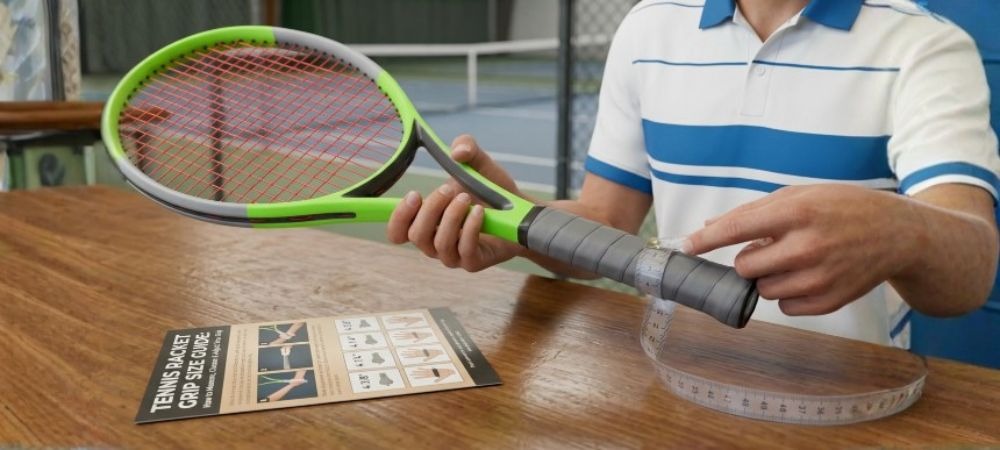
Your grip is the only direct connection between your hand and the racquet.
When the size is correct, players typically experience:
When grip size is incorrect, players often compensate unconsciously by gripping too tightly or struggling to stabilize the racquet during impact.
Over time, these compensations can negatively affect performance and comfort.
Tennis grip sizes are measured by the circumference of the racquet handle.
Most adult tennis racquets use the following sizing system:
| Grip Size | Circumference |
| L0 | 4 inches |
| L1 | 4 1/8 inches |
| L2 | 4 1/4 inches |
| L3 | 4 3/8 inches |
| L4 | 4 1/2 inches |
| L5 | 4 5/8 inches |
In North America, grip sizes are often listed directly as circumference measurements.
In many international markets, manufacturers use the L0–L5 system.
Although the differences appear small, even an eighth of an inch can noticeably affect comfort and control.
Many parents searching for tennis racket size by age focus primarily on racquet length, but grip size also plays an important role.
Junior players should be able to hold the racquet comfortably without excessive squeezing.
General guidelines include:
| Age Range | Common Junior Grip Size |
| 4–6 Years | L0 or smaller junior grips |
| 7–9 Years | L0 |
| 10–12 Years | L0–L1 |
| 13+ Years | L1–L2 (depending on hand size) |
These ranges are only starting points. Hand size varies significantly between players of the same age, so measuring the player’s hand remains the most reliable method.
There are two common methods used by players and coaches.
This is generally considered the most accurate approach.
To measure:
The measurement typically corresponds closely to your recommended grip size.
| Hand Measurement | Suggested Grip Size |
| 4 inches | L0 |
| 4 1/8 inches | L1 |
| 4 1/4 inches | L2 |
| 4 3/8 inches | L3 |
| 4 1/2 inches | L4 |
| 4 5/8 inches | L5 |
This provides a useful starting point but should not be treated as a strict rule.
Personal preference always matters.
Many players use this simple on-court method.
Hold the racquet using your normal forehand grip.
If you can comfortably fit the index finger of your opposite hand between your fingertips and palm, the grip size is generally appropriate.
If there is no room, the grip may be too small.
If there is excessive space, the grip may be too large.
The most common grip size among adult players is L3 (4 3/8 inches).
However, trends have changed over time.
Many modern players now prefer slightly smaller grips because they can:
This does not mean everyone should automatically use a smaller grip.
Comfort and control should always come first.
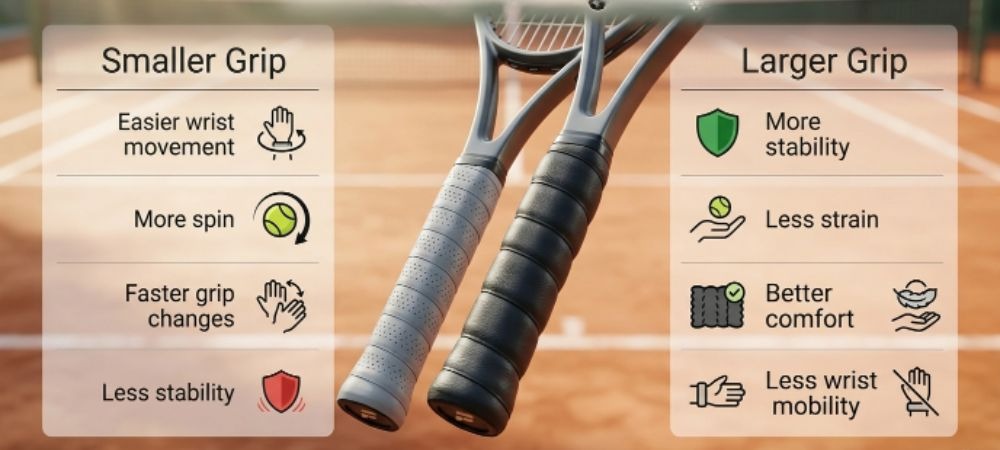
Both options have advantages and disadvantages.
Benefits:
Drawbacks:
Benefits:
Drawbacks:
The goal is finding the balance that complements your game.
Different playing styles often favor different grip characteristics.
Players who rely on aggressive topspin frequently prefer slightly smaller grips.
This can make it easier to accelerate the racquet and create racquet head speed.
Players who hit flatter shots often appreciate the added stability of a slightly larger grip.
As flat hitters typically drive through the ball with less topspin, they often rely heavily on precise racquet-face control. A grip that feels slightly more stable can reduce unwanted racquet movement at contact and help maintain directional accuracy during aggressive baseline exchanges.
Touch, feel, and quick grip changes are important.
Many net players choose moderate grip sizes that balance maneuverability and stability. During a typical point, serve-and-volley players may switch rapidly between continental, forehand, and backhand grip positions. An overly large grip can make these transitions feel slower and less natural, particularly during fast exchanges at the net where reaction time is limited.
Newer players generally benefit from a grip that closely matches standard sizing recommendations.
Extreme adjustments are rarely necessary during early development. For most adult beginners, grip sizes between L2 (4 1/4″) and L3 (4 3/8″) provide a practical starting point, depending on hand size. The goal is not to chase professional preferences but to find a comfortable grip that allows relaxed swings, proper technique development, and consistent contact.
A grip that is too small often creates excessive hand activity during swings.
Common signs include:
Players sometimes mistake these symptoms for technical problems when equipment may actually be contributing.
An oversized grip creates a different set of challenges.
Common symptoms include:
Many players describe oversized grips as feeling bulky or awkward during extended matches.
Some grip problems are obvious.
Others develop gradually and are often blamed on technique, fitness, or confidence instead.
Subtle warning signs include:
Many players focus first on grip size because it is the part of the racquet they feel directly. However, if grip adjustments do not solve the problem, the next area worth evaluating is string condition. Fresh strings often restore consistency, comfort, and predictability long before they actually break, which is why serious players pay close attention to their restringing schedule.
Fortunately, yes.
Grip size can often be modified without replacing the racquet.
The easiest solution is adding an overgrip.
Benefits include:
One overgrip typically increases grip size by approximately half a size.
This approach works particularly well for players who are between sizes or experimenting with different setups. Because overgrips are inexpensive and easy to replace, they provide a low-risk way to fine-tune comfort before making permanent adjustments.
Thicker replacement grips can create larger adjustments.
This option works well for players who need more substantial changes.
Unlike overgrips, replacement grips alter the base feel of the handle itself. Players who consistently feel that their grip is too small often prefer this option because it creates a cleaner, more permanent adjustment without layering multiple overgrips on the handle.
Professional technicians can install heat shrink sleeves beneath the grip.
These sleeves can increase grip size by a full size while maintaining a clean appearance.
This solution is commonly used by competitive players who have already confirmed their preferred grip size and want a long-term modification. Installation is typically performed by experienced racquet technicians or stringing professionals familiar with racquet customization.
Grip size is not the only factor affecting feel.
Different manufacturers use slightly different handle shapes.
Some brands feature:
Two racquets with identical grip sizes may still feel noticeably different because of handle shape.
This explains why players sometimes prefer one brand despite using the same official grip size.
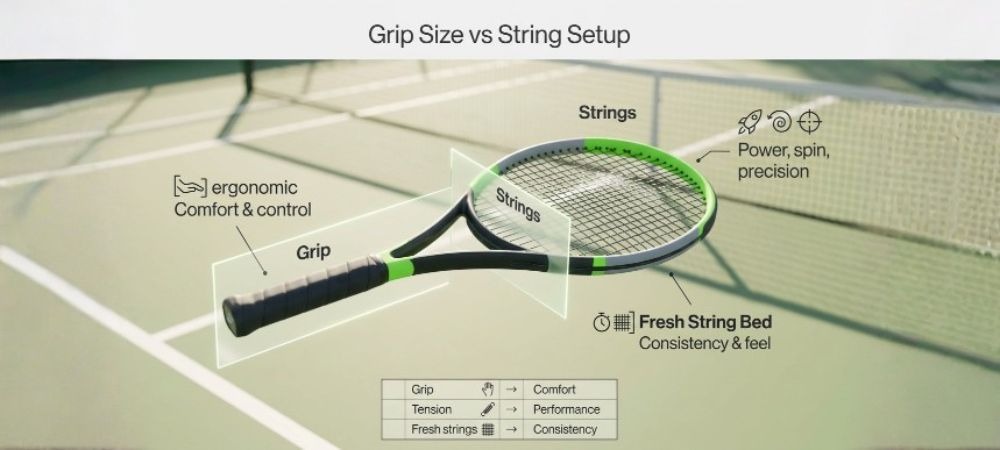
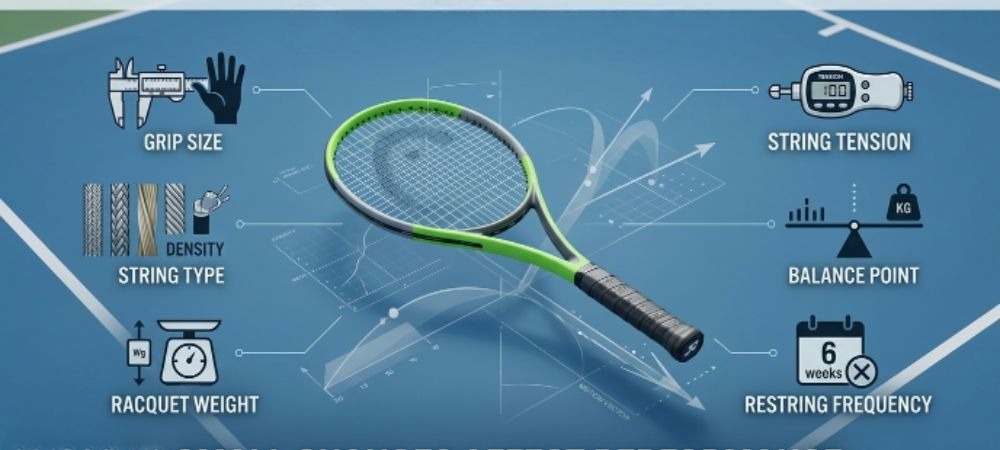
Grip size is only one piece of the performance puzzle.
Many players spend significant time optimizing their handle while overlooking other factors that affect comfort and consistency.
String tension influences:
Similarly, restringing frequency affects:
The most effective setups consider all three elements together:
| Setup Component | Primary Impact |
| Grip Size | Comfort and control |
| String Tension | Power and precision |
| Fresh Strings | Consistency and feel |
Players who want to maximize performance should evaluate grip size alongside string tension and restringing habits rather than treating them as separate decisions.
At higher levels, equipment consistency becomes increasingly important.
Competitive players monitor:
Even small changes can affect confidence and execution during important matches.
Professional players understand that performance consistency rarely comes from a single equipment choice. Grip size, string tension, string type, racquet balance, and restringing frequency all work together to influence how a racquet performs during competition.
This attention to complete setup management is something Rubin Statham understands firsthand.
As an ATP professional tennis player, former #1 New Zealand Davis Cup Player, and founder of Pro Stringer, Rubin experienced years of performance variation caused by inconsistent equipment setups while competing around the world.
During one year on tour, he and his twin brother spent more than $17,000 on restringing labor while still dealing with inconsistencies from different machines and technicians.
That experience helped inspire the creation of Pro Stringer and reinforced an important lesson for serious players: consistency matters.
Whether it involves grip size, string tension, or restringing quality, small equipment details can have a significant impact on performance over time.
The right grip size does more than improve comfort.
It helps create trust in your equipment.
When your racquet feels natural in your hand:
Players perform best when they stop thinking about their equipment and start focusing entirely on the match.
That level of trust comes from building a setup that works consistently every time you step on court.
Tired of adjusting your grip size only to find that your racquet still feels inconsistent from match to match?
Once grip size is dialed in, string condition and tension consistency are often the next variables affecting performance. Many players discover that what feels like a grip problem is actually the result of aging strings, tension loss, or inconsistent stringing quality.
This challenge is exactly what Rubin Statham set out to solve after spending more than $17,000 on restringing labor during his professional career while still dealing with inconsistent string jobs from different machines and technicians.
Players who string their own racquets with the Pro Stringer Platinum 3.0 Tennis or Pro Stringer CybeX gain greater control over tension accuracy, restringing consistency, and overall racquet setup. Instead of relying on varying shop standards, they can maintain a more predictable feel every time they step onto the court.
The most common grip size for adult players is L3 (4 3/8 inches), although many players prefer slightly smaller or larger sizes depending on comfort and playing style.
Yes. Overgrips, thicker replacement grips, and heat shrink sleeves can all increase grip size without replacing the racquet.
Neither is universally better. Smaller grips may improve maneuverability and spin, while larger grips can increase stability and comfort. The best choice depends on personal preference and playing style.
Common signs include racquet twisting, excessive grip pressure, forearm fatigue, and reduced stability during impact.
An incorrect grip size may contribute to excessive muscle tension and poor mechanics, which can increase stress on the arm and potentially contribute to discomfort over time.