
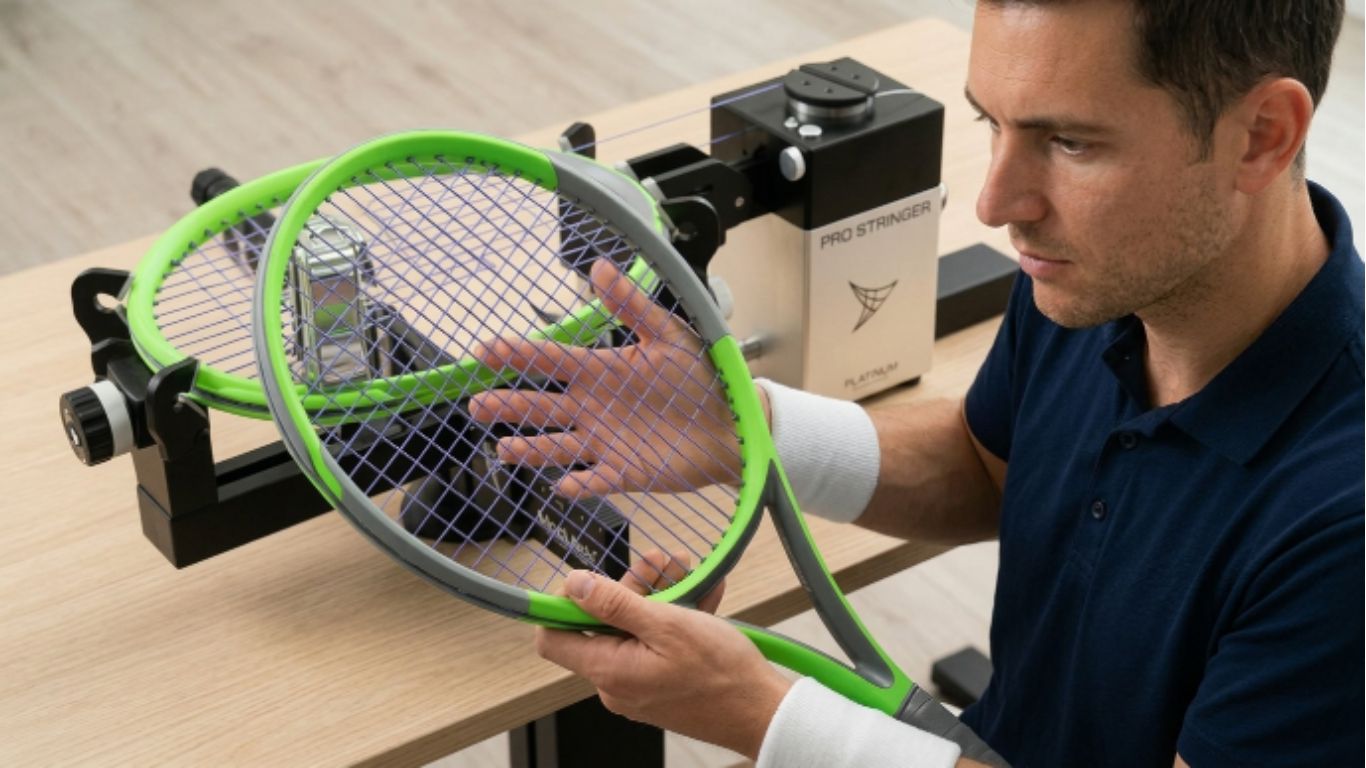
Every tennis player invests significant time into selecting the perfect racquet frame, string brand, and tension. Yet, many completely overlook one of the most vital variables in equipment optimization: tennis string gauge.
String gauge simply refers to the thickness of the string, and it plays a massive role in how your racquet behaves at impact. The gauge you choose directly dictates your access to easy power, heavy topspin, precise control, arm comfort, and durability.
In fact, two players can use the exact same racquet frame, string brand, and tension, yet experience completely different performance results simply because one is using a 15-gauge string and the other is playing with an 18-gauge string.
Professional players pay close attention to these micrometric variations. Understanding how tennis string gauge works allows you to make data-driven equipment decisions, building a personalized setup that complements your natural biomechanics rather than working against them. In this comprehensive guide, we will break down the mechanics of string thickness, analyze how it impacts performance, and help you select the ultimate configuration for your game.
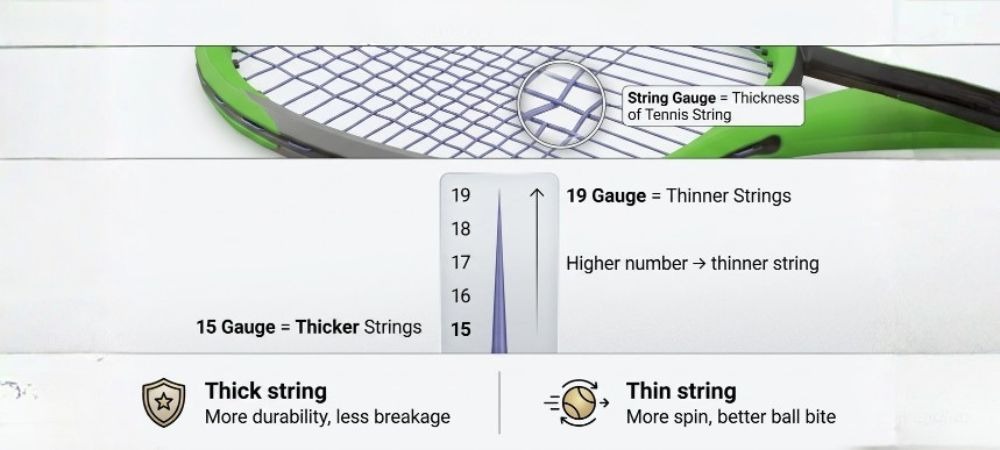
Tennis string gauge refers to the thickness of a tennis string.
Unlike many sports products where larger numbers indicate larger sizes, tennis string gauges work in reverse:
Most tennis strings fall between 15 and 19 gauge.
The thinner the string, the more it can bite into the ball and stretch during impact. Thicker strings generally offer greater durability and resistance to breakage.
| Gauge | Approximate Thickness | Main Characteristics |
| 15 | 1.41–1.49 mm | Maximum durability |
| 15L | 1.34–1.40 mm | Durability with slightly better feel |
| 16 | 1.26–1.33 mm | Balanced durability and control |
| 16L | 1.22–1.26 mm | Popular balance of spin and durability |
| 17 | 1.16–1.24 mm | Enhanced spin and feel |
| 18 | 1.10–1.16 mm | Excellent touch and responsiveness |
| 19 | Below 1.10 mm | Maximum feel and ball pocketing |
For most recreational and competitive players, 16 gauge and 17 gauge remain the most popular choices.
Many players focus exclusively on tension while overlooking gauge.
In reality, string gauge influences:
A thicker string and thinner string can feel dramatically different even when installed at the exact same tension.
This is why equipment optimization requires considering gauge alongside string type and tension rather than treating them as separate decisions.
One of the biggest reasons players choose thinner strings is increased spin production.
Because thinner strings can grip the ball more effectively and move more freely within the string bed, they often create better snapback and ball bite.
Players who rely heavily on topspin frequently prefer 17 or 18 gauge strings.
Thin strings provide greater feedback during impact.
Many players describe them as more responsive and connected to the ball.
This can be particularly valuable for:
Ball pocketing refers to how deeply the ball sinks into the string bed during impact.
Thinner strings generally increase pocketing, which can improve feel and confidence.
Because thinner strings stretch more during contact, they can generate slightly more power compared to thicker alternatives.
Players with moderate swing speeds often appreciate this additional depth.
The primary drawback is shorter lifespan.
Thinner strings wear out faster and break more frequently, particularly for heavy topspin players.
As strings rub against each other, grooves called notches develop.
Thin strings tend to notch more quickly, reducing performance over time.
Durability is the main reason players choose thicker strings.
Frequent string breakers often move to 15, 15L, or 16 gauge options.
These strings can withstand greater stress before breaking.
Thicker strings typically develop notches more slowly, helping them maintain playability longer.
Although thicker strings may cost the same initially, their longer lifespan often reduces annual restringing expenses.
Many players find thicker strings less responsive during touch shots. This difference becomes most noticeable on drop shots, half-volleys, and delicate net play where precise feedback from the string bed helps players judge pace and placement. Serve-and-volley players often prefer thinner gauges because they provide a more connected feel during these situations.
While modern string technology helps offset this difference, thicker strings generally generate less bite and snapback than thinner alternatives. Players who rely heavily on topspin may notice that thicker strings produce slightly less ball rotation, particularly when compared with thinner gauges of the same string model. During long baseline rallies, this can make it harder to create the heavy topspin trajectories that help keep aggressive shots inside the lines.
Some players feel thicker strings produce a stiffer overall string bed. While many competitive players appreciate this added stability, others may find it less forgiving during defensive rallies or when absorbing pace from hard hitters. Players with arm sensitivity may also prefer a thinner gauge or softer string material to maintain comfort.
Many players assume gauge and tension are separate decisions.
They are actually closely connected.
Thinner strings often feel more lively and powerful. Because of this, some players compensate by increasing tension slightly.
Thicker strings generally feel firmer and more controlled. Players may occasionally lower tension to maintain comfort.
Choosing the right gauge is only half of the equation. Once you’ve identified a gauge that suits your game, the next step is finding the tension that allows it to perform at its best. A thinner gauge strung too loosely may feel overly lively, while a thicker gauge strung too tightly may feel harsh and unforgiving. Our Tennis String Tension Guide: Choosing the Right Tension for Your Racquet explains exactly how to balance gauge and tension to create a setup that matches your playing style.
| Gauge | Common Tension Approach |
| 15–16 Gauge | Often strung slightly lower for comfort |
| 16L–17 Gauge | Balanced tension range |
| 18–19 Gauge | Often strung slightly higher for control |
These are starting points rather than strict rules.
Personal preference always matters most.
Every player interacts with the ball differently.
This is why there is no universally perfect string gauge.
Players who generate significant racquet head speed often prefer:
Benefits include:
Players who hit flatter shots often choose:
This helps balance control and durability.
Touch and feel are critical at the net.
Many serve-and-volley players enjoy:
Most recreational players perform well with:
These provide a practical balance of performance and durability.
Tournament competitors frequently experiment with multiple gauges depending on:
One of the most common questions players ask is whether they should choose a 16 gauge vs 17 gauge tennis string. Both are extremely popular, and for most players the decision comes down to balancing durability against feel and spin.
| Feature | 16 Gauge | 17 Gauge |
| Durability | Higher | Lower |
| Spin Potential | Good | Better |
| Feel | Good | Better |
| Ball Pocketing | Moderate | Higher |
| String Break Resistance | Better | Lower |
| Most Suitable For | Frequent players and string breakers | Players prioritizing spin and feel |
If you regularly break strings or play several times per week, 16 gauge is often the safer choice because it lasts longer without sacrificing too much performance. If you rarely break strings and want maximum feel, touch, and spin potential, 17 gauge is often worth considering.
For players who are unsure, 16 gauge remains the most versatile starting point. It provides a reliable balance of durability, control, comfort, and spin while allowing you to experiment later as your game develops.
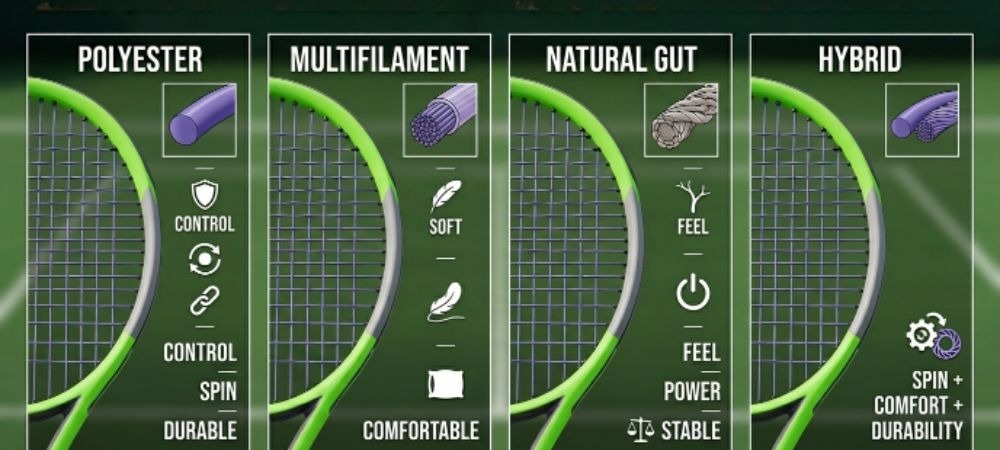
Gauge is only one part of the equation.
Different string materials respond differently even at identical gauges.
Polyester remains popular among advanced players because of:
Most players use polyester in:
Very thin polyester can break quickly for heavy hitters.
Multifilaments are softer and more comfortable.
Many players choose:
to balance comfort and lifespan.
Natural gut provides exceptional:
Many players use slightly thicker gauges because the natural gut already offers excellent responsiveness.
Hybrid configurations combine different string types.
Popular examples include:
Hybrids allow players to balance:
While gauge affects durability, feel, and spin potential, string profile also plays an important role in overall performance. Different string shapes interact with the ball differently, which is why many players evaluate both gauge and profile when building their ideal setup.
Players looking for a clean, predictable response often prefer round-profile polyester strings. Pro Stringer Silver Bullet combines a smooth round profile with Opti-Stretched Processing and HyperGlide Surface Technology to create effortless power, easy spin, and a lively response.
The round geometry allows the strings to move freely and recover quickly after impact, helping generate excellent snapback and consistent ball flight. Players who prioritize comfort, pace, and all-court versatility often find that a 16 or 17 gauge round-profile string provides a strong balance of performance and playability.
Key Attributes:
Players seeking maximum spin often gravitate toward shaped polyester strings. Pro Stringer Blue Steel features a precision square profile designed to increase ball bite and reward aggressive swings with heavy rotation.
The sharp edges help grip the ball during impact, making Blue Steel particularly appealing for players who rely on topspin to control pace and create margin over the net. Many competitive baseliners pair spin-focused strings like Blue Steel with 16L or 17 gauge options to maximize spin potential while maintaining control.
Key Attributes:
For players looking to balance spin, pace, and versatility, Pro Stringer Black Hex offers a different approach. Its precision hexagonal profile features six engineered edges that engage the ball from multiple contact angles, creating consistent bite while preserving fast string movement and snapback.
This combination makes Black Hex well-suited for modern players who want to shape the ball aggressively without sacrificing pace. Players who enjoy an all-court game often find that Black Hex delivers a strong balance of spin generation, control, and responsiveness across a variety of playing styles.
Key Attributes:
All three strings utilize Pro Stringer’s shared technologies:
The ideal combination of gauge, string material, and string profile ultimately depends on your playing style. Some players prioritize durability, others prioritize spin, while many seek a balanced setup that delivers reliable performance across every area of their game.
Durability becomes increasingly important for frequent players.
Heavy hitters often notice significant differences in lifespan between gauges.
| Gauge | Relative Durability |
| 15 | Excellent |
| 15L | Very High |
| 16 | High |
| 16L | Moderate-High |
| 17 | Moderate |
| 18 | Low |
| 19 | Very Low |
The more spin you generate, the faster strings wear.
Common signs of string wear include:
Many players mistakenly wait until strings break before replacing them.
Performance usually declines long before visible breakage occurs.
Finding the right gauge is only valuable if your strings continue performing the way they were intended. As strings wear, notch, and lose tension, even the perfect gauge can begin to feel inconsistent. If you’re unsure when to replace your strings or how often you should restring, our Tennis Racquet Restringing Guide: How to Restring for Better Performance explains the warning signs players should watch for and how regular restringing helps maintain consistent performance.
Recommended gauges:
Focus on:
Recommended gauges:
Focus on:
Recommended gauges:
Focus on:
Recommended gauges:
Focus on:
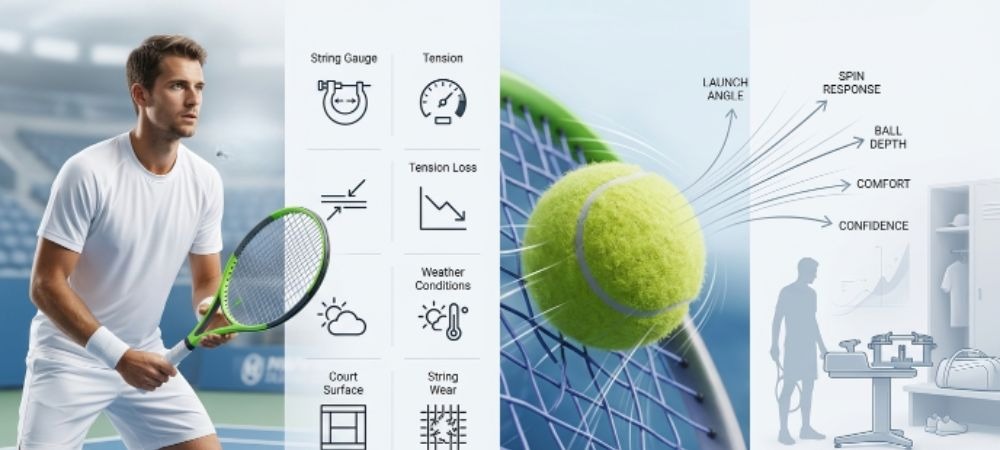
At higher levels, consistency becomes everything.
This is why serious players do not simply choose a string gauge once and forget about it. After spending time testing different gauges and tensions, players want confidence that their racquet will perform the same way every time it is restrung. Unfortunately, maintaining that consistency can be difficult when different stringers, machines, and techniques produce different results, even when the requested specifications remain the same.
Professional players do not simply choose a string brand and forget about it.
They monitor:
Even small differences can affect:
This attention to detail is something Rubin Statham understands firsthand.
As an ATP professional tennis player, former #1 New Zealand Davis Cup Player, and founder of Pro Stringer, Rubin experienced the challenges of inconsistent stringing throughout years of professional competition.
During one year on tour, he and his twin brother spent more than $17,000 on restringing labor while still dealing with inconsistencies caused by different stringers, machines, and techniques.
That experience led him to build Pro Stringer and develop a portable electronic stringing system that allows players to maintain greater control over their equipment wherever they compete.
Choosing the right tennis string gauge is one of the simplest ways to improve racquet performance.
Thinner gauges generally offer more spin, feel, and responsiveness, while thicker gauges provide greater durability and longevity. Neither option is universally better. The right choice depends on your playing style, string material, skill level, and performance goals.
The most successful players approach string setup as a complete system, balancing gauge, tension, material, and restringing frequency together rather than focusing on only one variable.
Tired of finally finding the right string gauge only to have your racquet come back feeling different after every restring? Even small inconsistencies in stringing technique, machine calibration, or tension accuracy can change how your carefully chosen setup performs on court. Take control of your string gauge, tension, and overall racquet consistency with Pro Stringer’s portable electronic stringing machines and accessories. Built from Rubin Statham’s experience competing on the professional tour and dealing with inconsistent string jobs across different tournaments, Pro Stringer helps players achieve reliable, repeatable results whether they are training at home, traveling internationally, or preparing for competition.
Most players perform best with 16 or 17 gauge strings because they provide a strong balance of durability, spin, comfort, and control.
Generally, yes. Thinner strings often provide better ball bite, increased snapback, and improved spin potential compared to thicker strings.
15 gauge and 15L gauge strings typically offer the greatest durability and resistance to breakage.
Most beginners benefit from 16 gauge strings because they provide durability, comfort, and forgiveness without sacrificing performance.
Yes. Thinner strings generally provide slightly more power and ball pocketing, while thicker strings usually offer a firmer, more controlled response.